
 Language


Why is cork flooring suitable for underfloor heating?
To know why cork flooring is suitable for underfloor heating, first you need to understand the conditions for becoming a suitable underfloor heating flooring.
Firstly, it is advisable to be thin rather than thick. The heat on the ground is transferred to the ground above through the floor, and there will inevitably be some loss in between. Therefore, the floor suitable for laying in geothermal environments should first reduce the heat loss to a small extent. The thickness of the floor directly affects the heat conduction speed. Therefore, the floor should be thin rather than thick. Generally, solid wood flooring is 10-14mm, solid wood composite flooring is 15-20mm, and cork flooring is only 4mm.
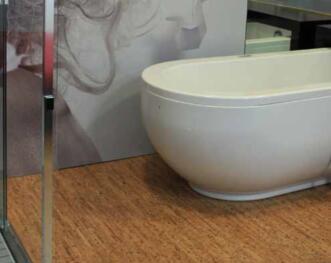
Secondly, temperature changes do not cause deformation. Entering winter, as the weather turns cooler and urban heating begins, there will be a significant temperature difference indoors. Therefore, the adaptability and control of the floor to temperature are also very important. Ground heating should consider this aspect even more, otherwise it will cause cracking and deformation of the floor. The structure of general flooring is fibrous, such as solid wood composite flooring and reinforced wood flooring. Temperature changes can cause some parts to overheat or become too low, and they are transmitted along the fibers. If the force is uneven, it is easy to cause deformation of the flooring. However, green grid cork flooring will dissipate and decompose heat when heated, and temperature changes from minus 60 ℃ to above 80 ℃ have no effect on it.
Thirdly, the emission of formaldehyde is low. Generally, when tested at room temperature, the formaldehyde release of flooring is within the standard range. However, in geothermal environments, the higher the temperature, the higher the formaldehyde release. The formaldehyde release of cork flooring has been tested by national authoritative departments. At room temperature, the formaldehyde release is almost zero, and in geothermal environments, the formaldehyde release will not exceed the standard.
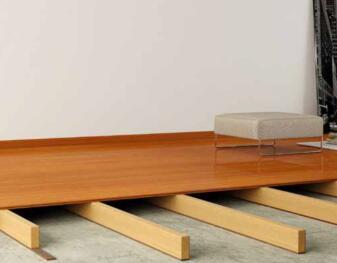
Fourth, good insulation and slow heat dissipation. Generally, the insulation performance of flooring is poor. Once the external source is removed, the flooring will quickly cool down. However, when cork flooring is heated by an external heat source, it does not stop absorbing heat due to the high specific heat capacity of cork. On the contrary, it is stable and rising. When the external source is suddenly removed, due to the internal effect of cork, the heat dissipation rate is slower and the insulation performance is better than other materials.
It can be seen from this that cork flooring is not wrong to be called a floor suitable for underfloor heating.